
"Africa's rising middle class" is not an industrial strategy.
If consumption rises faster than production, the import bill rises, foreign exchange drains, and the state eventually responds with controls or rationing. That is not ideology. That is arithmetic.
Manufacturing Requires a System
Sustained manufacturing expansion requires four conditions:
-
Power and logistics reliability: If electricity is unstable and logistics are expensive, manufacturing becomes charity.
-
Regulatory predictability: Investors will tolerate taxes. They won't tolerate surprise.
-
Cost competitiveness: Not just wages—also port efficiency, inland transport, and input costs.
-
Export discipline: If you cannot export, you cannot sustainably earn foreign exchange.
Morocco's Tanger Med industrial zones illustrate the model: 1,400 companies, 130,000 workers, automotive and aeronautics exports integrated into European supply chains. This happened because logistics infrastructure preceded industrial policy, not vice versa.
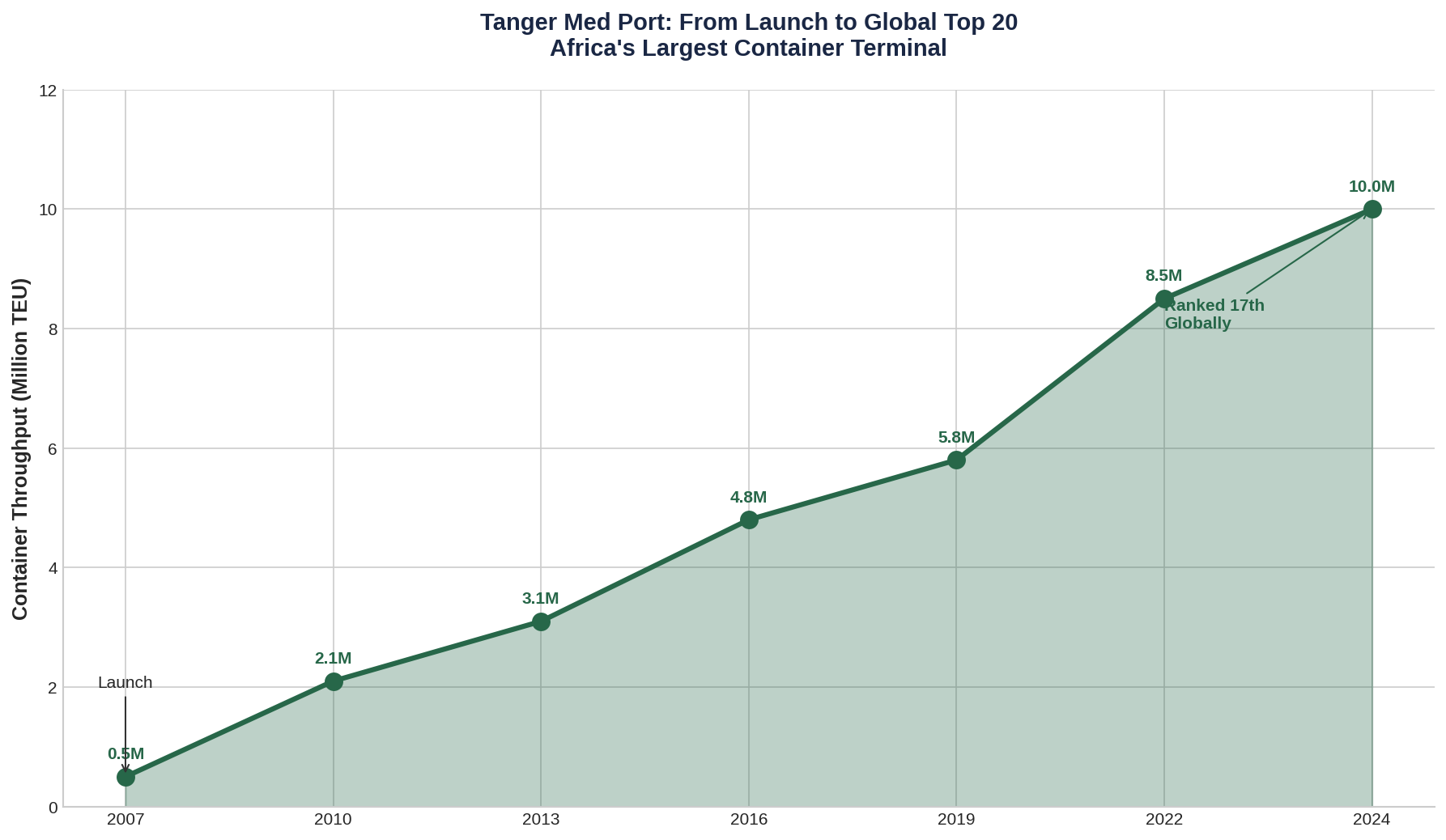
Tanger Med: logistics infrastructure preceded industrial policy, not vice versa.
The World Bank's Container Port Performance Index (2023) ranked Tanger Med fourth globally for efficiency. That efficiency attracts manufacturers who require predictable just-in-time logistics. The causality runs from infrastructure credibility to industrial investment—not the reverse.
The Export Realism Model
Compounding states usually:
- Build export capability first
- Enforce standards ruthlessly
- Kill failing industrial projects early instead of protecting prestige
Rwanda's ICT sector now accounts for 17 per cent of exports—a deliberate shift from primary commodities. Mauritius transformed from sugar monoculture to diversified services exporter. Neither had natural advantages beyond policy discipline.
Africa's industrial future will not be won by speeches about factories. It will be won by states that treat logistics, enforcement, and credibility as industrial infrastructure.
This is Part 8 of a 10-part series on African investment, state capacity, and capital allocation.
Previous: ← Part 7: Nigeria & South Africa