
There is a special tragedy reserved for giant economies: they are too important to ignore and too inconsistent to trust.
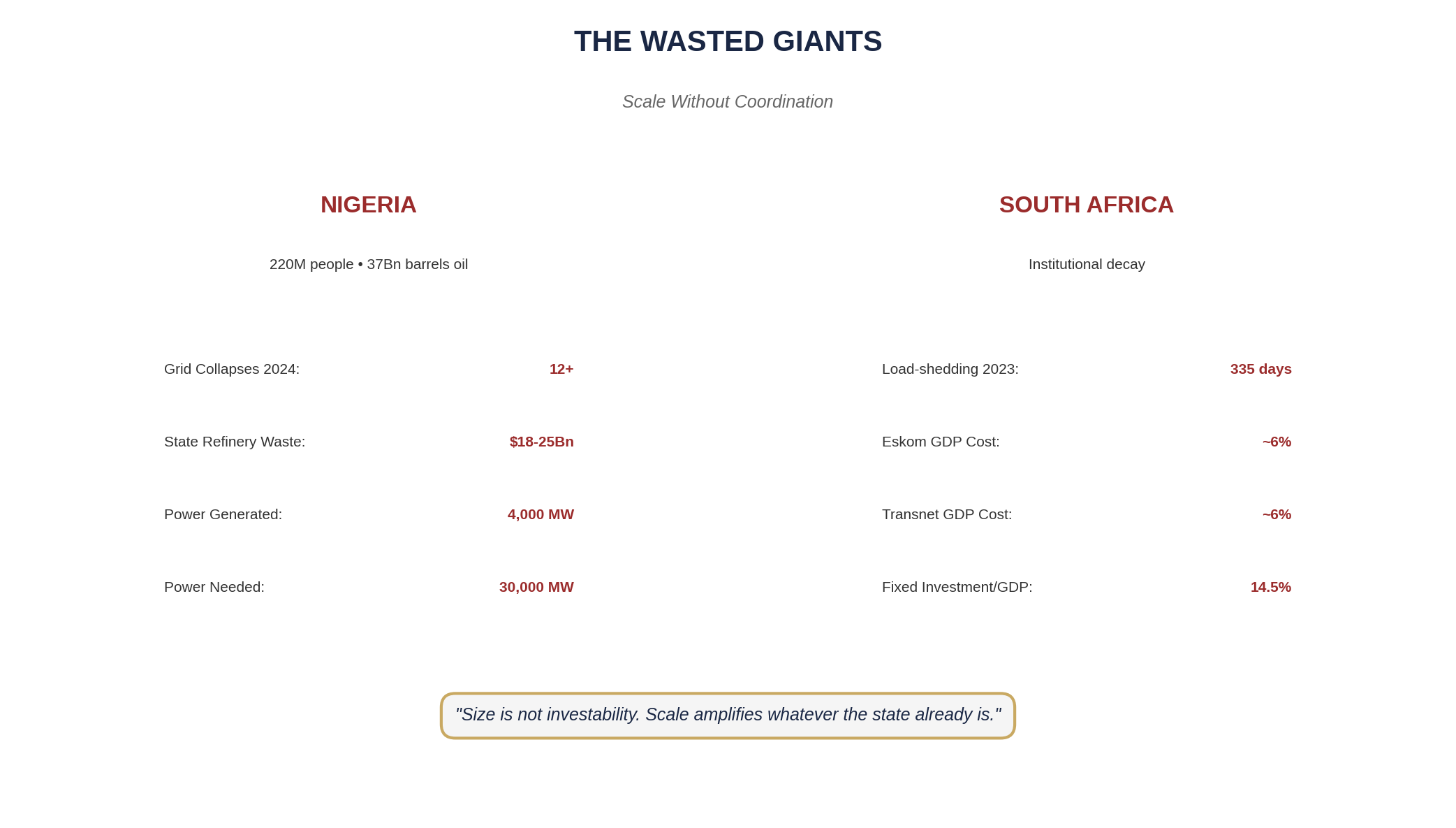
Two giants, two different failures: private energy trapped in allocation (Nigeria) versus institutional inheritance being liquidated (South Africa).
Nigeria: Energy Trapped in Allocation
Nigeria's private sector is relentlessly entrepreneurial. Lagos is one of the world's great informal economies. Yet the sovereign interface behaves like an allocation regime: discretion over foreign exchange, regulation, and enforcement creates an economy where survival is too often about access rather than productivity.
When discretion dominates, investors shorten tenor, demand higher returns, and shift from compounding capital to trading capital. Nigeria is not uninvestable. It is structurally short-term.
The $20 billion Dangote Refinery—the world's largest single-train facility—represents what private capital can achieve when it builds its own conversion machinery. Yet even this project faces operational challenges: catalyst leaks, unit shutdowns, and disputes with traders over crude supply. The state refineries that consumed $18–25 billion in maintenance remain offline. The contrast is instructive.
South Africa: Inheritance Being Liquidated
South Africa's advantage was institutional depth: functioning courts, sophisticated capital markets, reliable infrastructure. Its risk is institutional decay—where energy, logistics, and service delivery constraints translate into direct economic throttling.
The investor issue is not "news risk." It is system drift: slow deterioration that compounds quietly until it becomes acute. Fixed investment hovers around 14.5 per cent of GDP—compared to 25–30 per cent in robust emerging markets. The private sector's response—installing 6.1 gigawatts of solar by 2024, up from 1.2 gigawatts in 2021—illustrates both adaptation and the underlying failure.
Eskom implemented 335 days of load-shedding in 2023. Transnet cost the economy an estimated 6 per cent of GDP through port and rail inefficiency. These are symptoms of institutional hollowing: competent personnel replaced by connected ones, maintenance deferred, accountability eroded.
The Narrow Path Back
Turnarounds in giants require more than reform speeches. They require:
- Restoration of core state capability in infrastructure functions
- Reduced discretionary allocation so markets can price risk
- Political settlement where competence is rewarded rather than treated as factional threat
The giants are not doomed. But they are not "sleeping." They are awake, and the house requires rebuilding.
This is Part 7 of a 10-part series on African investment, state capacity, and capital allocation.
Previous: ← Part 6: Debt, Currency & the IMF Loop